


Historical background
This project commemorates the perseverance and determination of Joseph-Armand Bombardier, who worked tirelessly for a decade (1926–1936) in his garage in Valcourt, Québec, developing the sprocket wheel/track system. This invention revolutionized the transportation sector. This interactive comic strip provides an inside view of the inventor’s trial and error process, which eventually led to his success. An original and captivating story for young people to learn about what fueled his passion, while inspiring them to pursue their dreams. Find out more about Joseph-Armand Bombardier’s life and work below. Learn about the important locations of this bustling era, the people who played a role in the inventor’s life, and the inventions that marked his career.
Locations
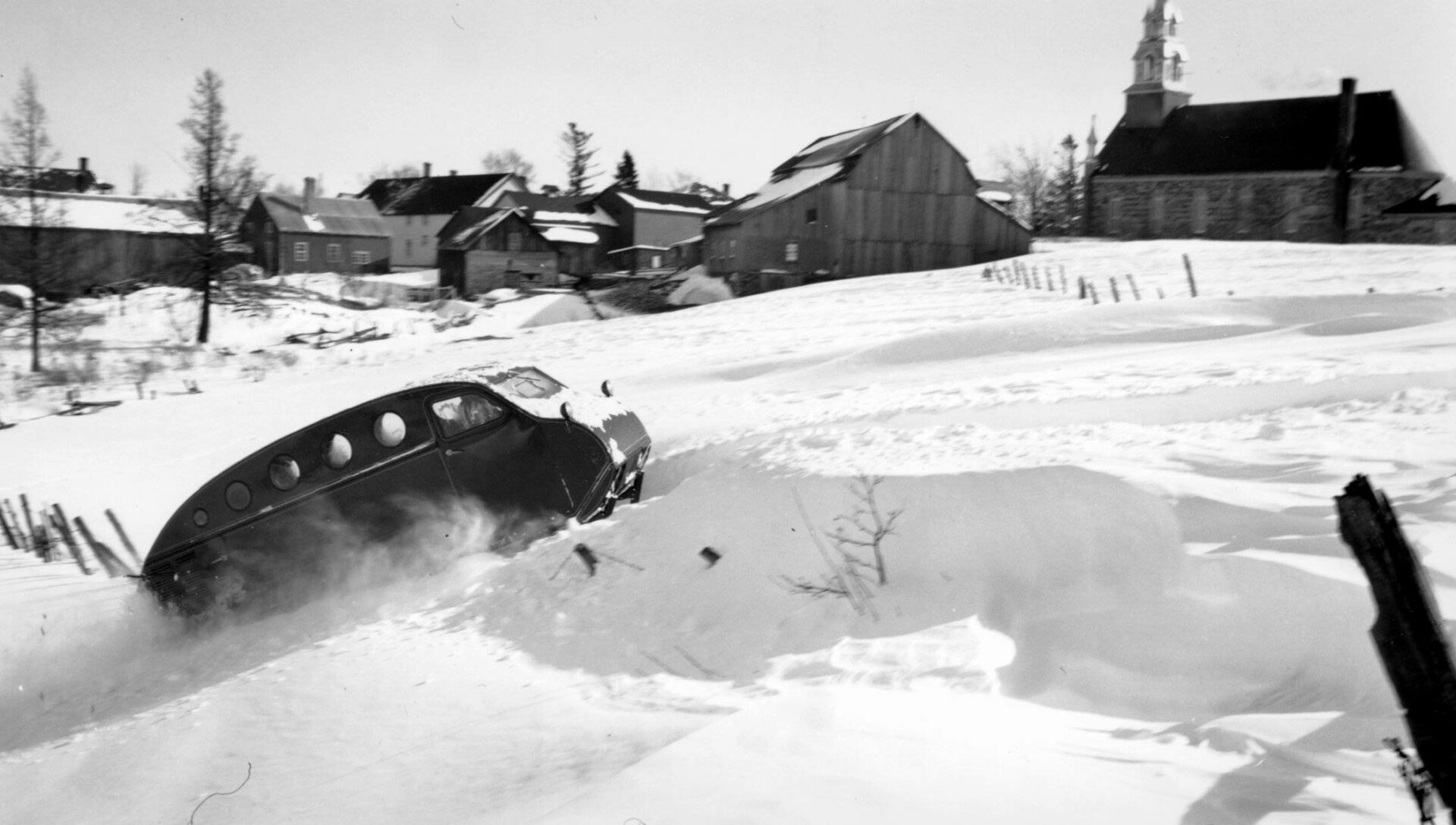
For a long time winter travel was difficult in Québec. As a large portion of the population lived in the country and streets were not cleared of snow, teams of horses were used to pack down the snow and people used sleighs to get around. Cars were difficult to handle on snow-covered roads. As most other Québec villages, Valcourt was isolated during winter, hindering motorized travel. In this Eastern Townships village, snow removal on roads was not implemented until the late 1940s. The inventor was fully committed to developing vehicles for travelling over snow. He focused his efforts on developing a vehicle that would overcome isolation and make winter transportation easier.
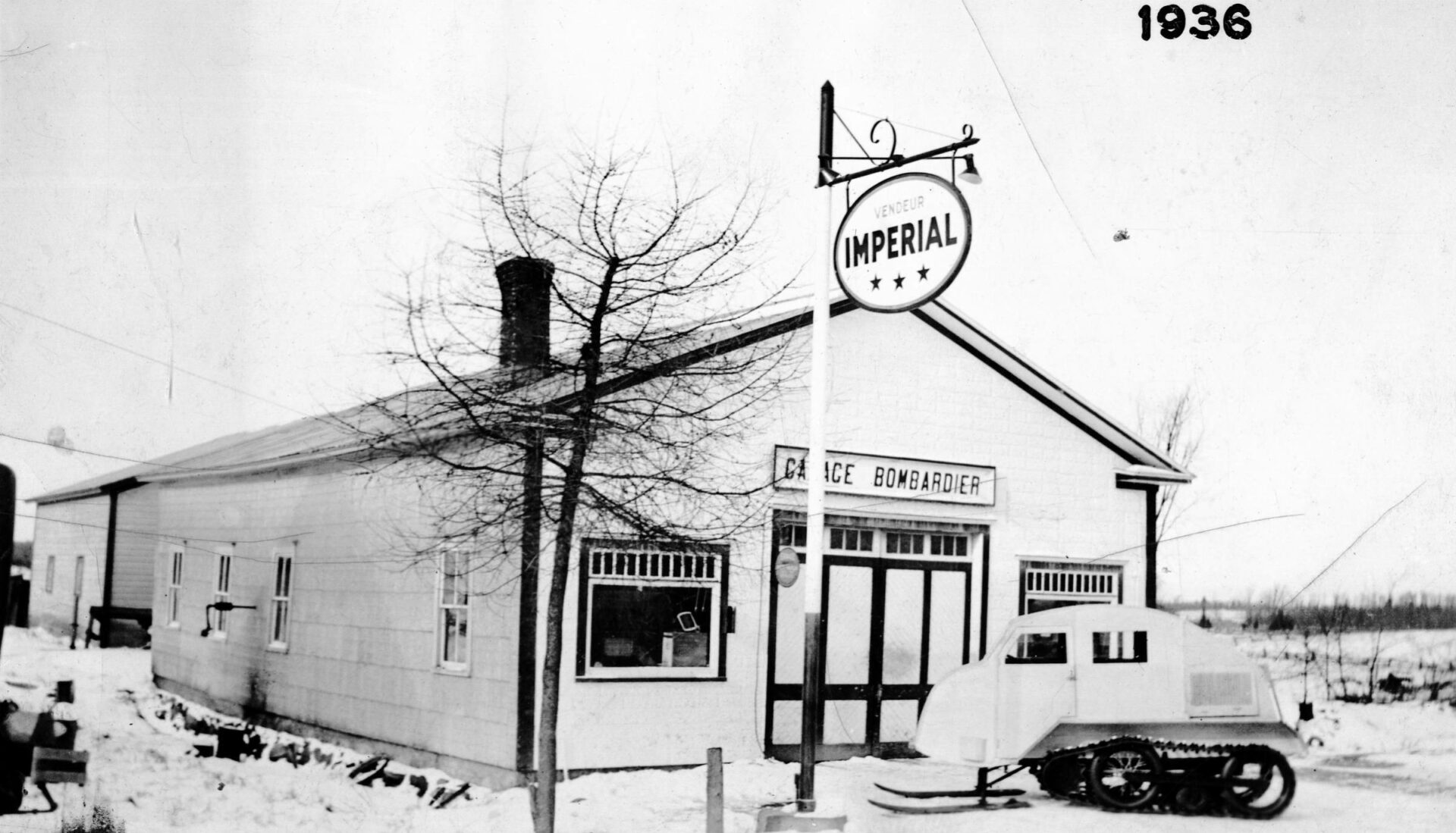
In 1926, Alfred Bombardier, Joseph-Armand’s father, bought a piece of land near the bridge in Valcourt. With help from his family and the community, he built a garage for his then 19-year-old son, who used it as an automotive and machinery repair shop. In 1929, the inventor acquired the property and expanded it. His attention gradually shifted to developing vehicles for travelling over snow, and by 1937 he worked exclusively on developing and manufacturing snowmobiles.
This is the building where the inventor called on his outstanding ingenuity and creativity despite having limited means at his disposal. Here he developed his first popular model: the B7. In 1968, the Fondation J. Armand Bombardier bought the building and moved it to its current address in 1971 to be part of a museum to honour the inventor’s memory. Since 2016, the original garage has been used to host a multimedia show in the Musée de l’ingéniosité J. Armand Bombardier, which pays tribute to this leading figure in Québec’s history.
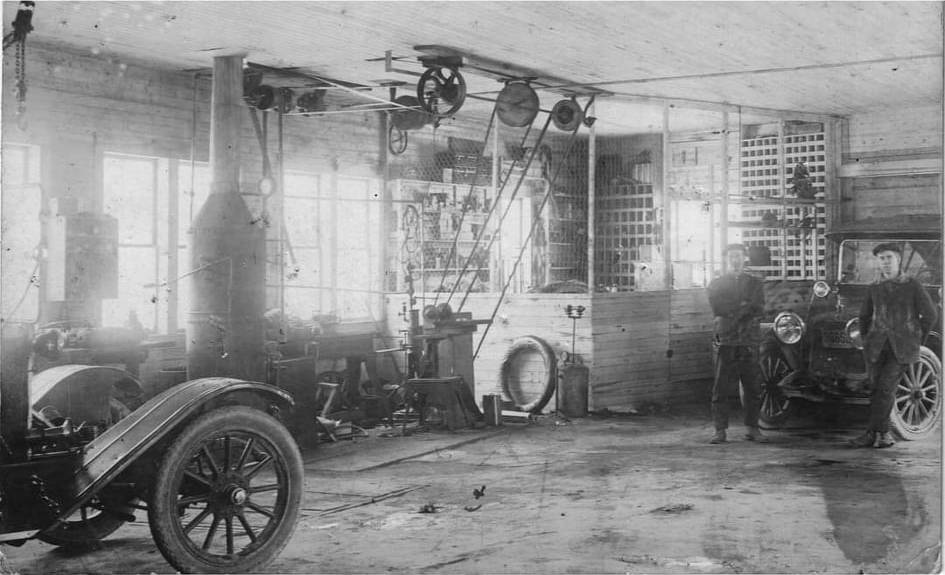
Interior view of Garage Bombardier, then used as an auto repair and mechanical shop. Joseph-Armand Bombardier had a remarkable ability to find solutions to any mechanical problem whether for automotive engines, table saws, agricultural pumps, and more, quickly earning him an excellent reputation in the area.
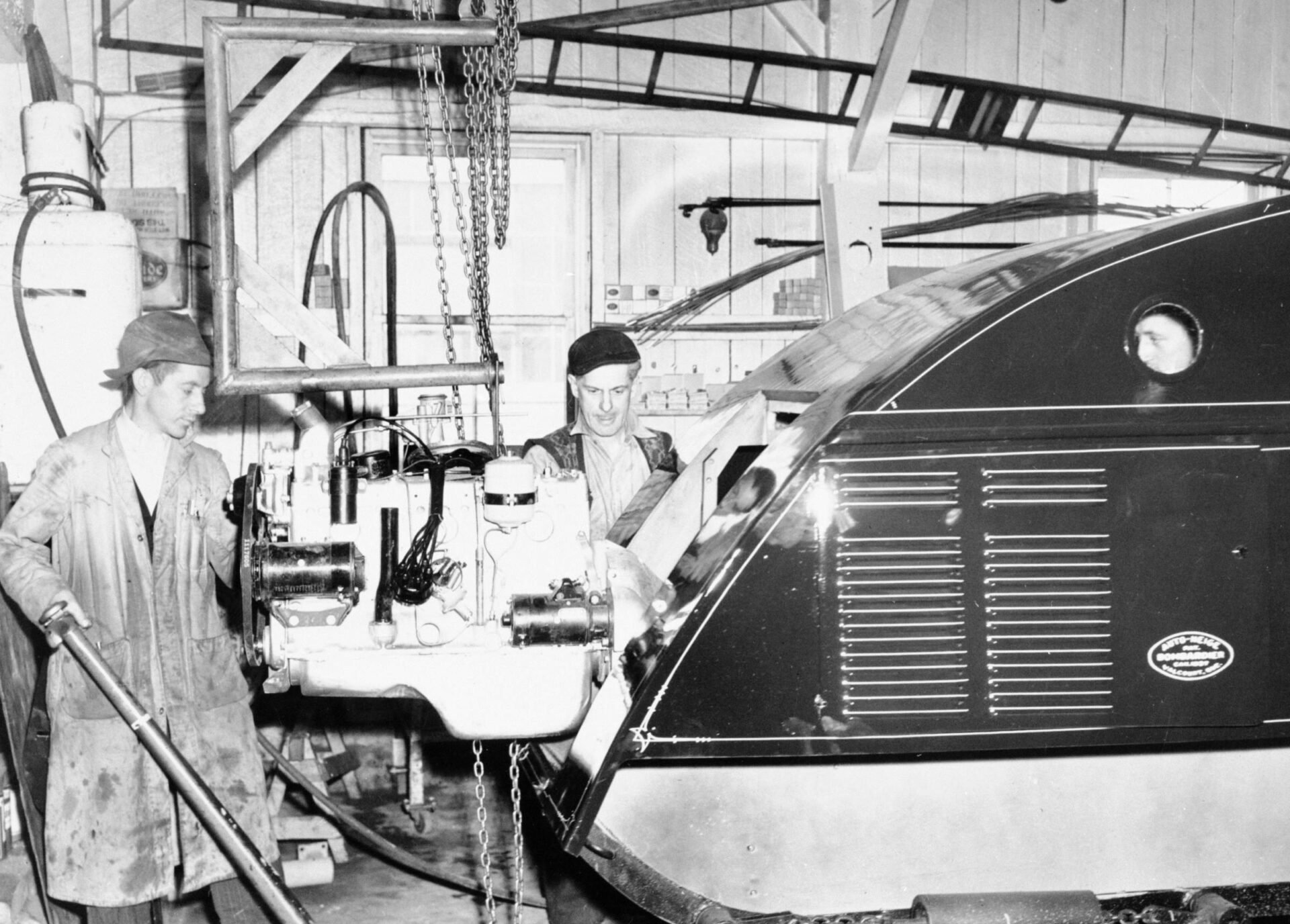
Workers assembling an engine for a Bombardier snowmobile. After Joseph-Armand Bombardier’s first factory was built in 1940, the Garage Bombardier was used for snowmobile assembly, storage, and washing of industrial vehicle parts until the 1960s.
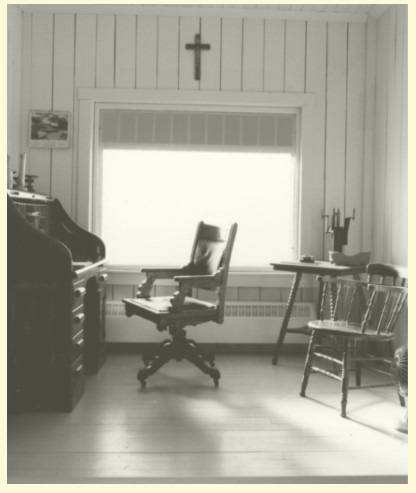
Joseph-Armand Bombardier’s office in Garage Bombardier, which the inventor occupied from 1926 until early 1941, when he moved his office to his new factory. When you visit the Musée de l’ingéniosité J. Armand Bombardier, you can see the inventor’s office in the original garage.
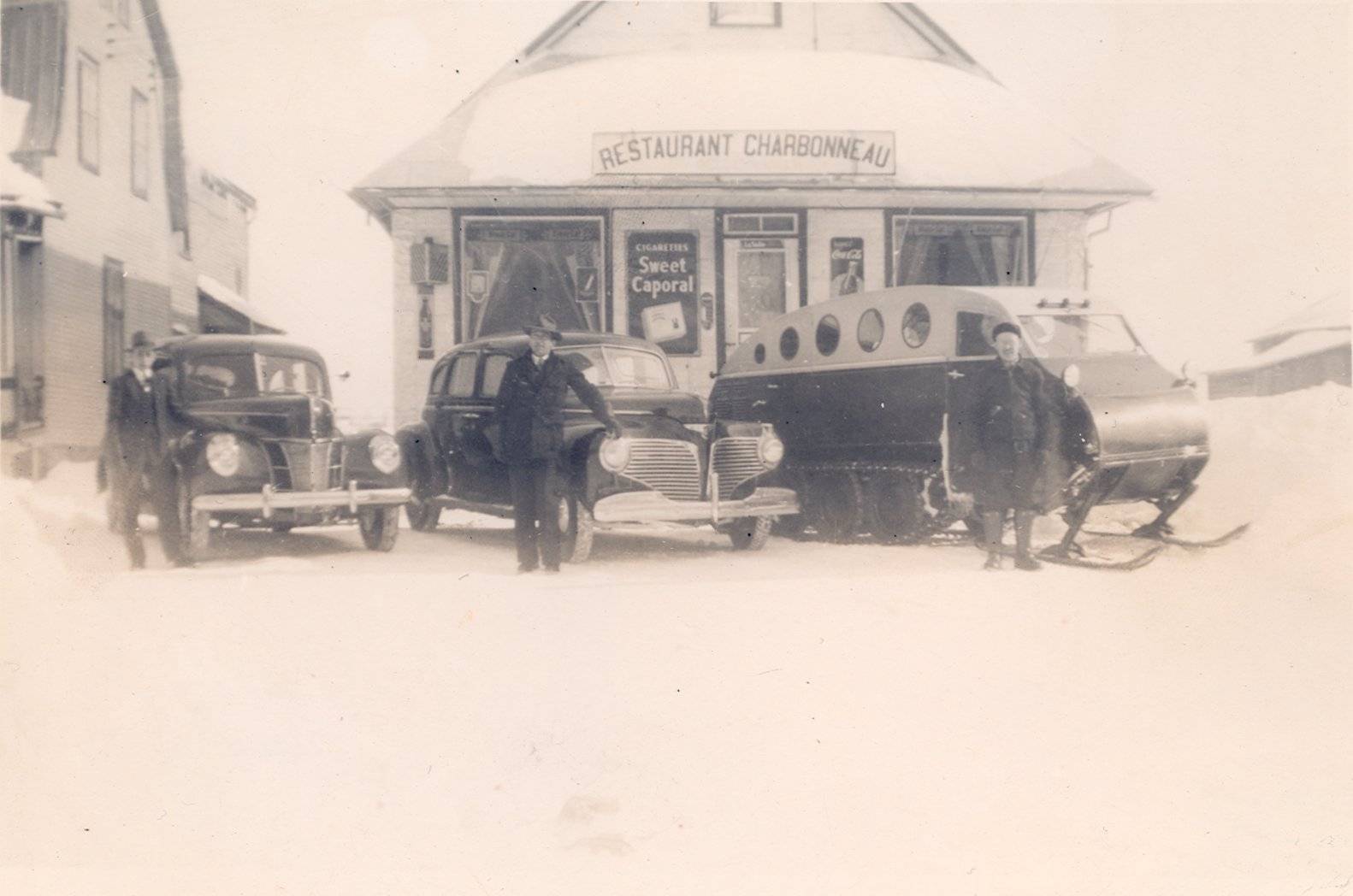
In the 1940s–1950s, Wilfrid Charbonneau owned a restaurant and billiard room in Valcourt; he is pictured here in the centre in front of his restaurant. Joseph-Armand Bombardier regularly played pool in this venue. Mr. Charbonneau was one of the first in Valcourt to operate a cab and snow cab service, using a B12 snowmobile in the 1940s to drive customers in winter.
His social circle – The people
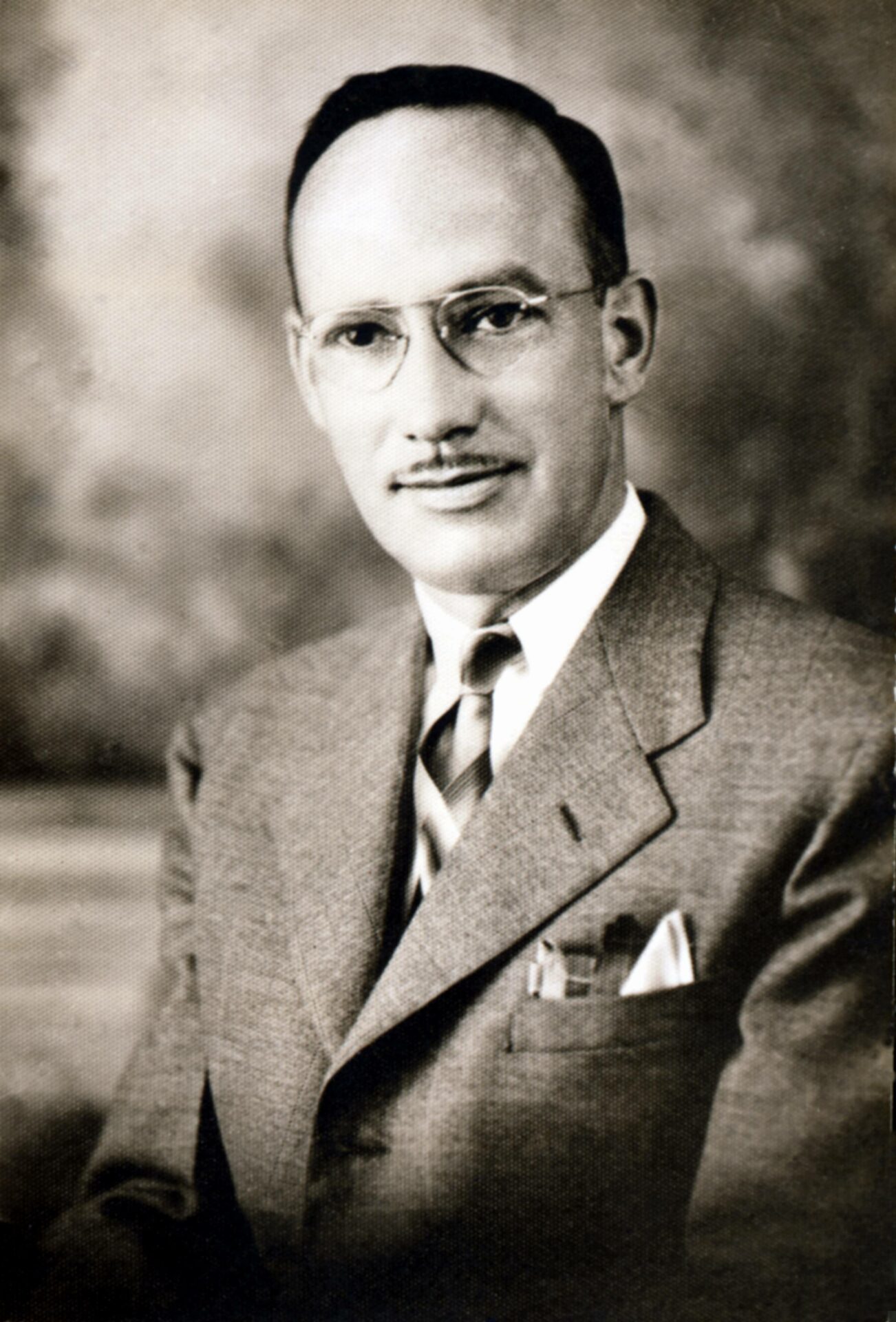
Born on April 16, 1907, in Valcourt, Québec, Joseph-Armand Bombardier is the eldest son of Alfred Bombardier and Anna Gravel. By the age of 13, he was already making mobile toys from clockwork components, and two years later he designed his first snow vehicle. Originally destined for priesthood, he only completed part his classical education program before his passion for mechanics took precedence over his studies. In 1926, he set up shop in Valcourt in the garage his father had built for him. There, he carried out tireless research work to solve the weight and traction problems posed by snow vehicles. In 1929, he married Yvonne Labrecque, with whom he had six children. An illustrious French-Canadian inventor, Joseph-Armand Bombardier is a renowned entrepreneur and a man committed to his community. He obtained 43 patents and developed an impressive number of specialized vehicles for both snow and off-road transportation.
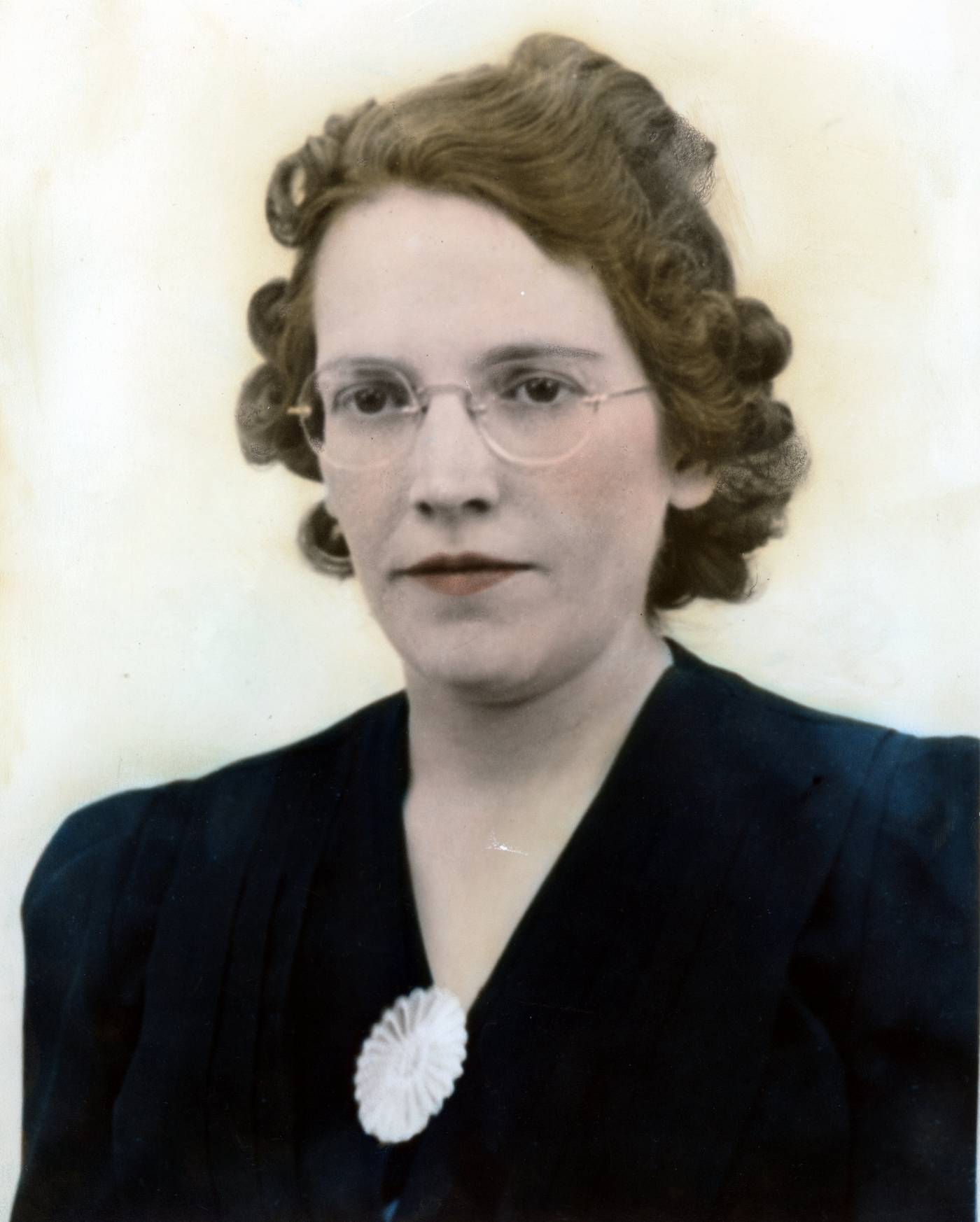
A kind-hearted woman imbued with great humanity, Yvonne Labrecque married Joseph-Armand Bombardier, the famous inventor, in 1929. She gave birth to six children: Germain, Yvon, Janine, Claire, Huguette, and André. Following her husband’s death in 1964, Mrs. Labrecque Bombardier took charge of Les entreprises J. Armand Bombardier. During his lifetime, Mr. Bombardier supported a number of community, educational, and cultural organizations, and was active as a volunteer. To perpetuate this involvement, in 1965 his wife set up one of the first francophone family foundations in Québec. With the help of her daughters Janine, Claire, and Huguette, she continued her husband’s work with the charities he supported throughout his lifetime. The Valcourt cultural centre and library are named in his honour.
Joseph-Armand Bombardier’s brother-in-law and associate.
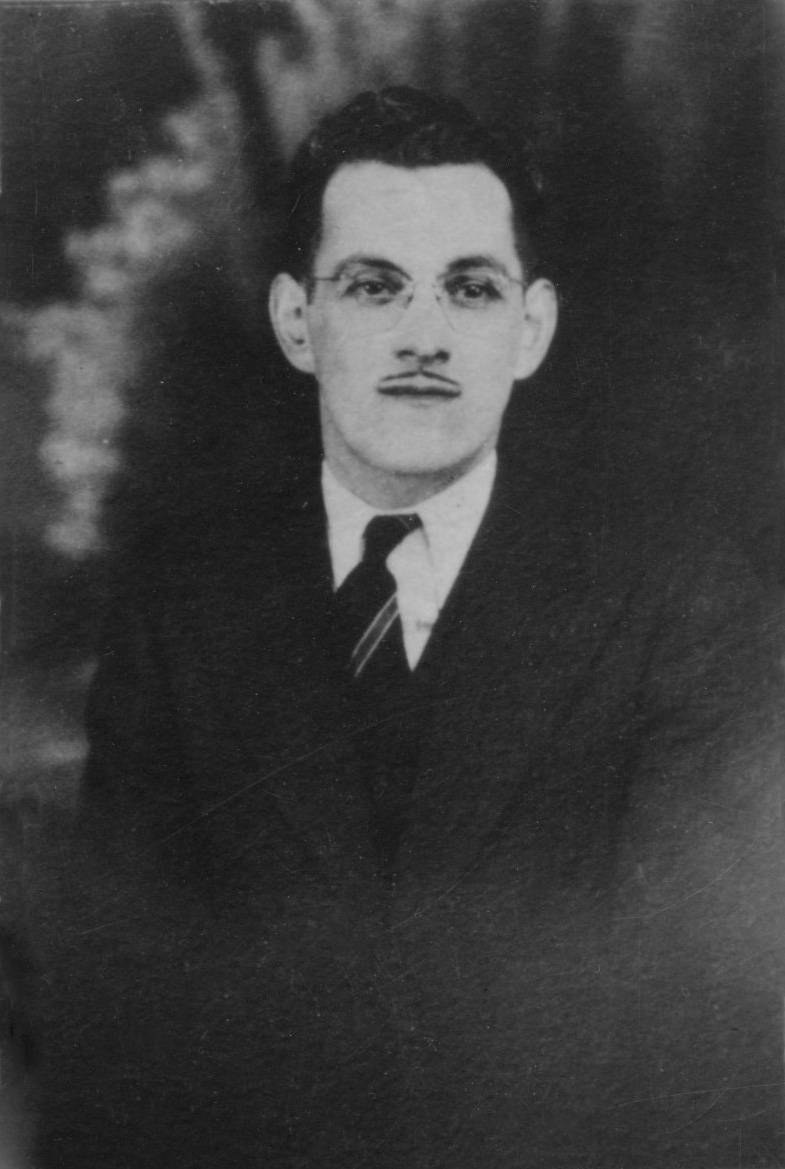
Brother of the inventor, shareholder and manager of L’Auto-Neige Bombardier Limitée.
Léopold assisted Joseph-Armand Bombardier in designing the 1922 vehicle, the first snow vehicle they tested during the 1921–1922 Christmas vacation. They managed to make a splash. However, the propeller presented a hazard dreaded by their father. He therefore ordered them to dismantle the 1922 vehicle.
Léopold was heavily involved in the reconstruction of certain vehicles for the Musée J. Armand Bombardier, which opened in 1971.

The second son of Joseph-Armand Bombardier and Yvonne Labrecque died of peritonitis in 1934 at the age of two and a half. They were unable to get their son Yvon to the hospital in time, and his death was a turning point in the inventor’s life, who put his attempts to develop a small vehicle on the backburner to focus his efforts on producing a multi-passenger vehicle. He redoubled his efforts to develop his 7-passenger B7 snowmobile. Here we can see Yvon next to his brother Germain.
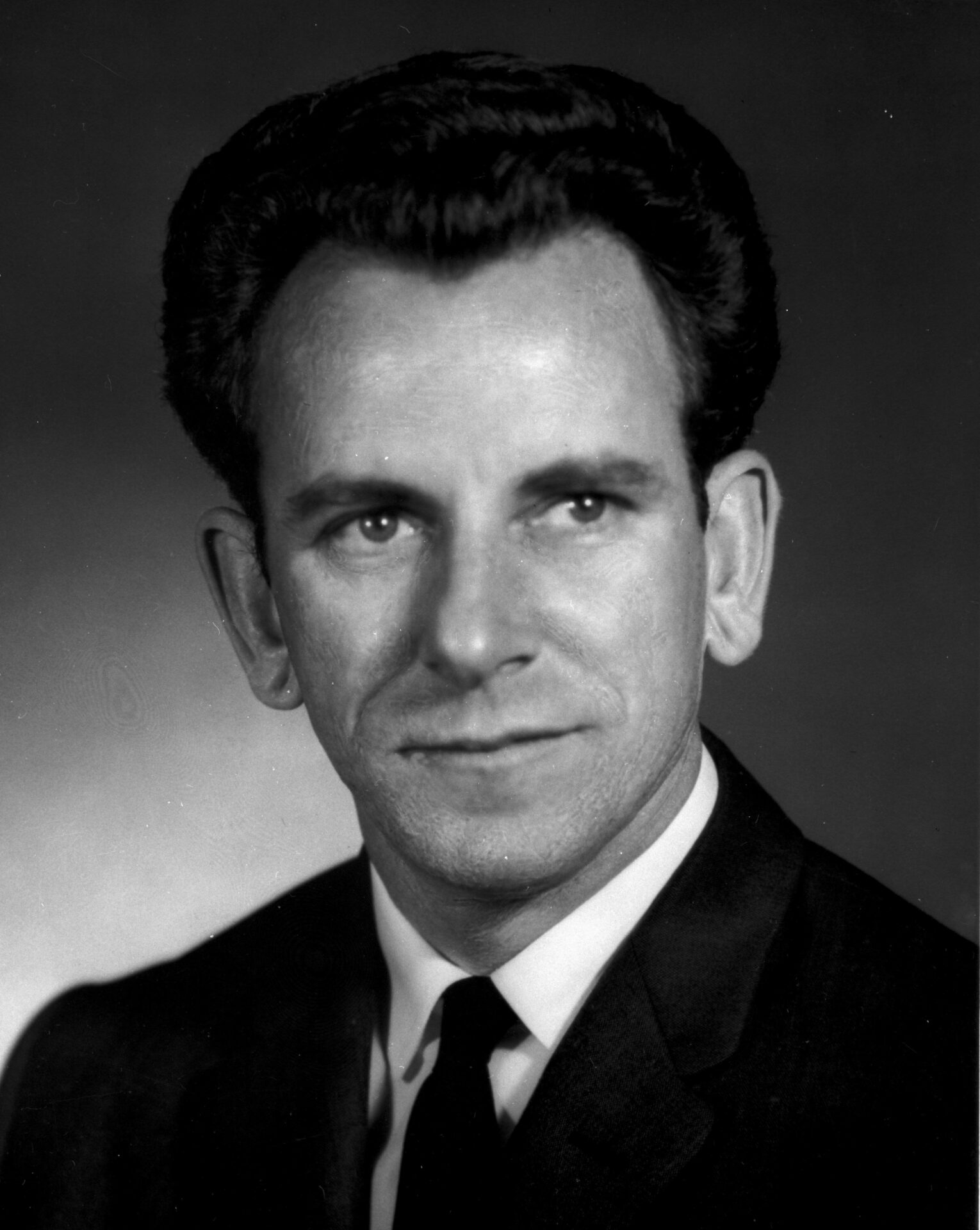
The eldest child of Joseph-Armand Bombardier and Yvonne Labrecque, Germain, began working with his father at L’Auto-Neige Bombardier at an early age. He eventually joined the first team with his uncles Alphonse, Léopold and Gérard, as well as Mrs. Marie-Jeanne Dupaul and Mr. Roland Saint-Pierre. He obtained patents, some of which are related to the Ski-Doo® snowmobile. In the 1950s, he was in charge of the Rockland Accessories Ltd. division in Kingsbury. In the late fifties and early sixties, he became increasingly involved with his father in the company’s operations in Valcourt. On his father’s death in 1964, he became president of the company until 1966.
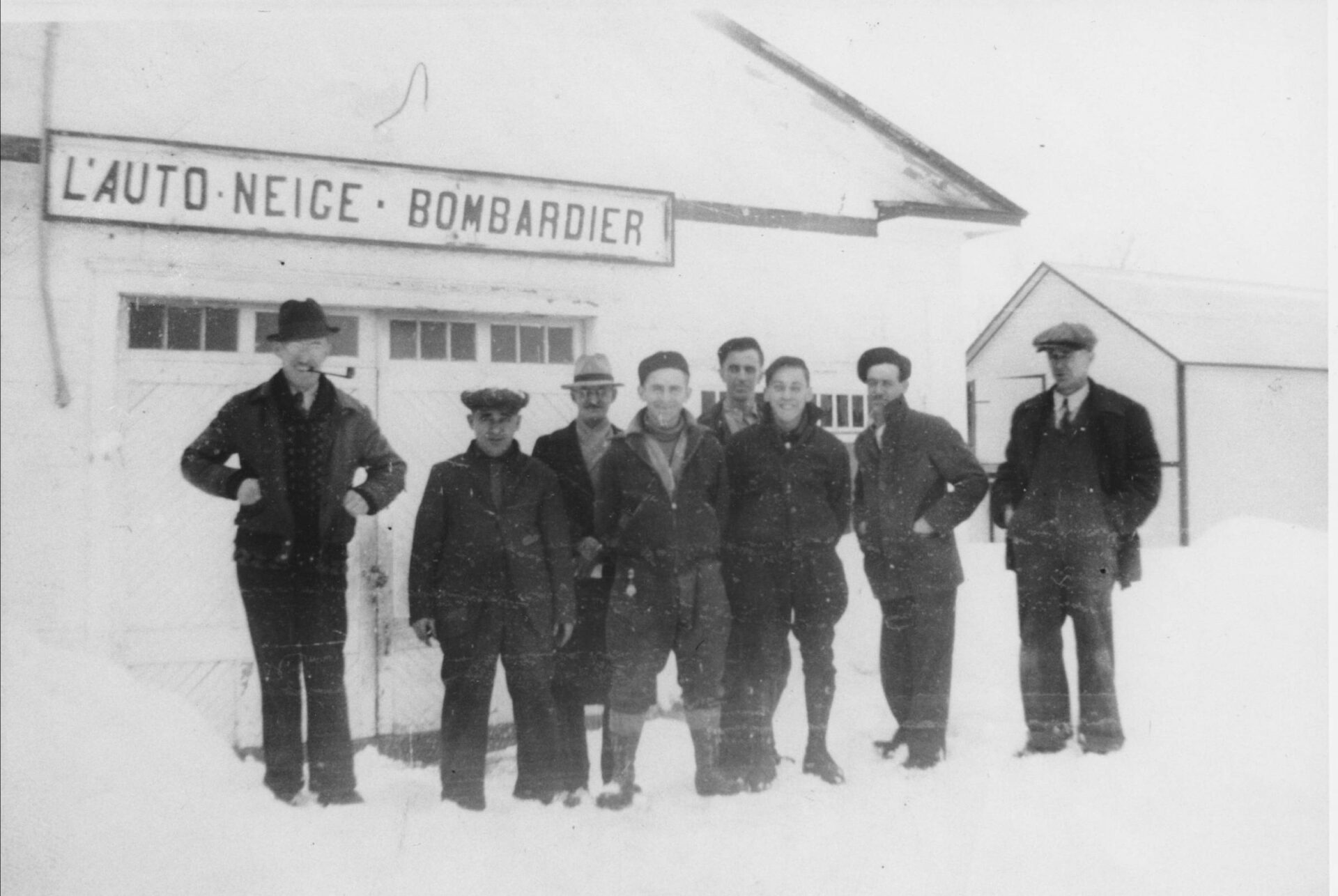
Joseph-Armand Bombardier and seven of his employees in 1937. These are Joseph-Armand Bombardier’s first employees, from left to right, in front of Garage Bombardier, which became L’Auto-Neige Bombardier in 1937: Joseph-Armand Bombardier, Joseph Houle, Léonard Désilets, Philippe Bombardier, Laurent Malouin, Gérard Bombardier, Patrice Cousineau, and Isaïe Boissé.
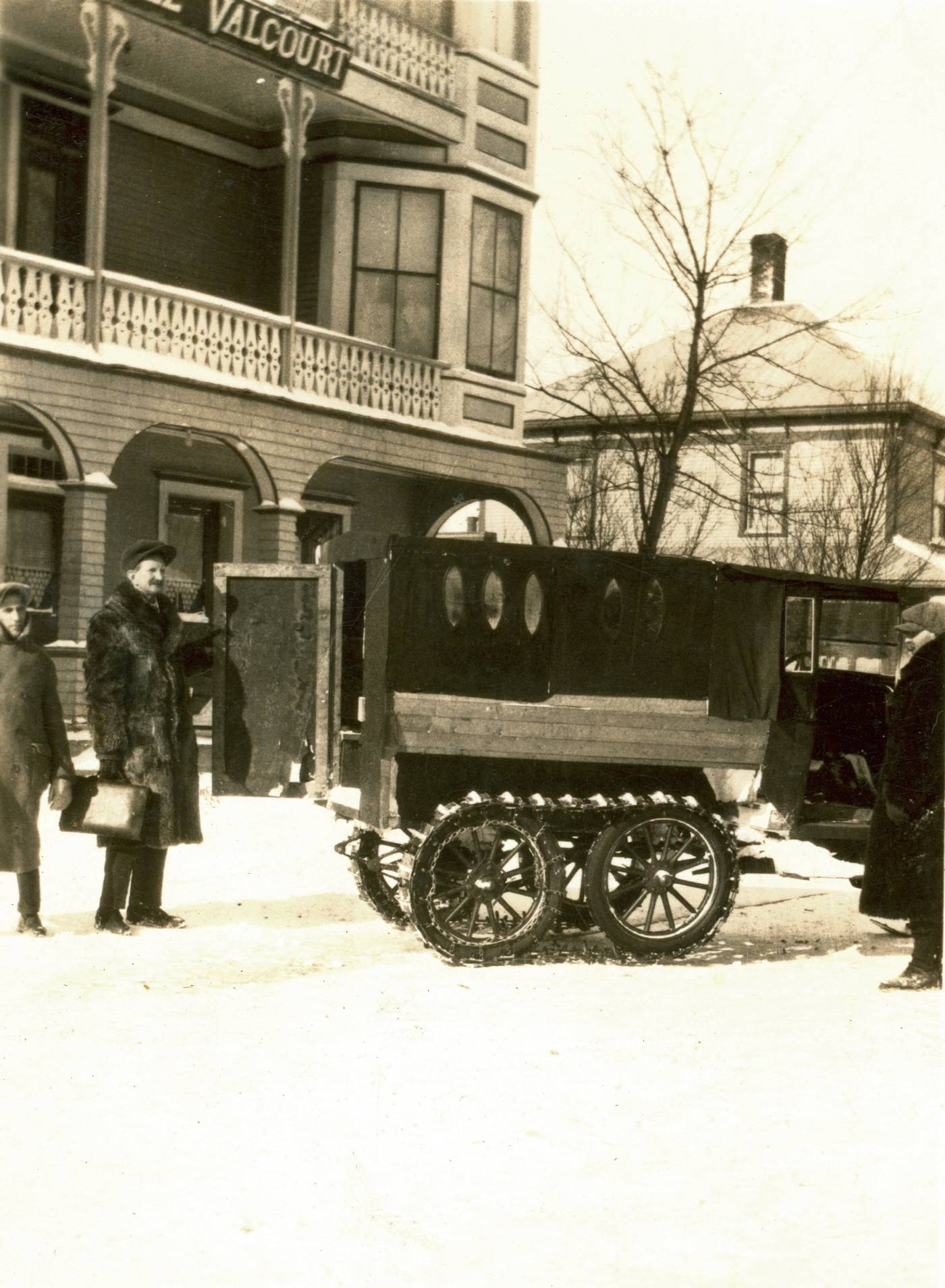
Dr. Phydime Langlois was the first doctor to practise in Valcourt, from 1903 to 1938.
In October 1903, he became the owner of a large house in which he set up his medical practice. Here, he is standing alongside one of Joseph-Armand Bombardier’s prototypes in front of the Valcourt hotel.
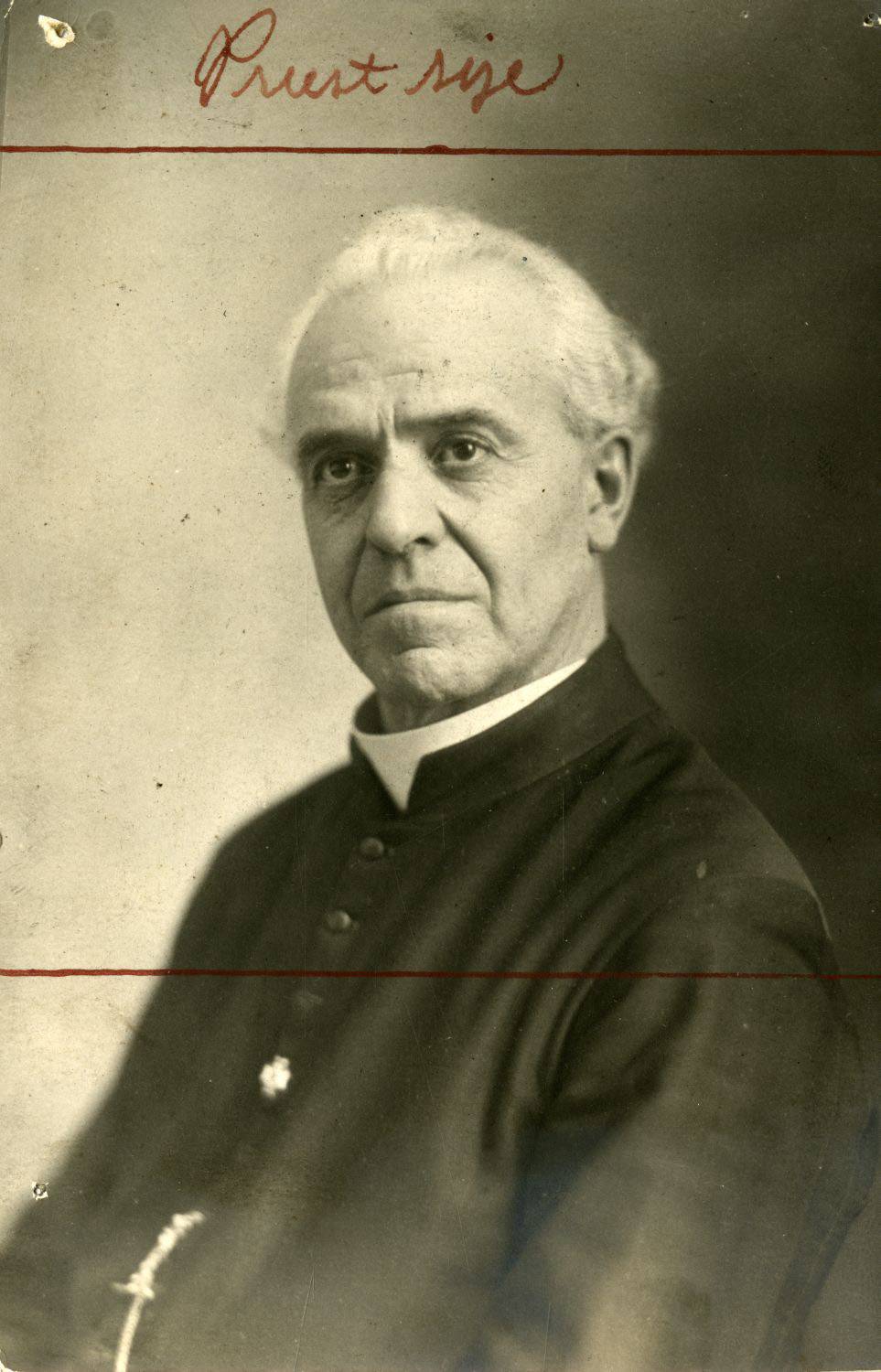
Joseph-Arcade Éthier, parish priest of Saint-Joseph-d’Ely in Valcourt from 1924 to 1940.
The inventions
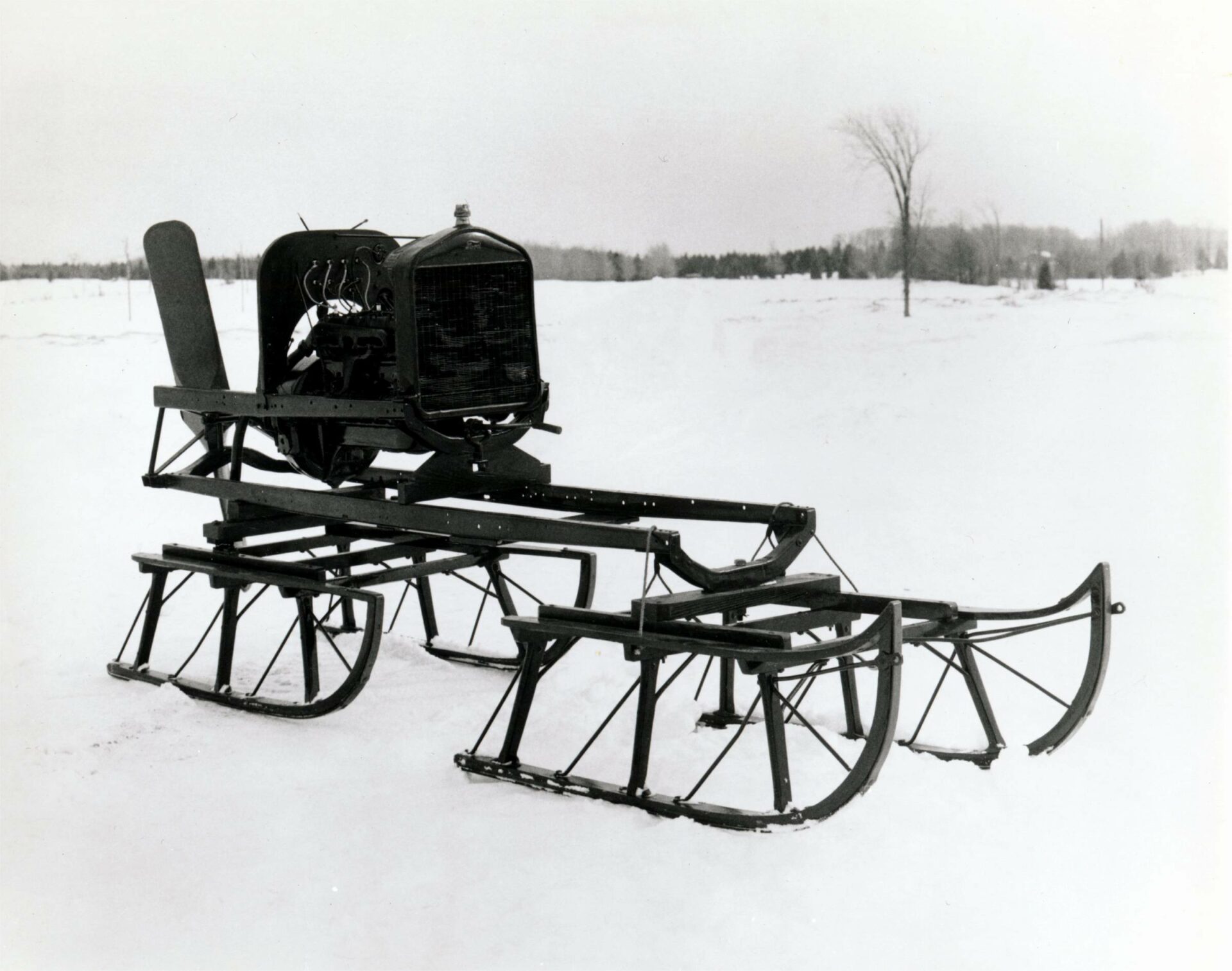
Gliding on snow is an idea that inspired Joseph-Armand Bombardier from an early age. At the age of 15, during the holiday season, he built his very first snow vehicle. A skilled mechanic, he brought back to life the faulty engine of a Ford Model T given to him by his father Alfred Bombardier. After combining a Ford engine that he hooked up to sled runners and a propeller, which was installed at the rear of the vehicle, his brother Léopold and he went on a spectacular ride through the village!
However, the propeller presented a hazard dreaded by their father. So he ordered them to dismantle it, which they did, but this didn’t stop them!
The Musée de l’ingéniosité J. Armand Bombardier owns two of these vehicles:
- The first is a faithful reconstruction produced for the permanent exhibition of the Musée J. Armand Bombardier, which opened in 1971. It was made to the specifications of Léopold and Alphonse-Raymond Bombardier, brothers of the inventor, for the Museum.
- The second is a replica made for the 1992 Bombardier miniseries on the life and work of Joseph-Armand Bombardier. In 1991, the Museum acquired the vehicle built by Messrs. Bissonnette, Marcheterre, and Moisan.
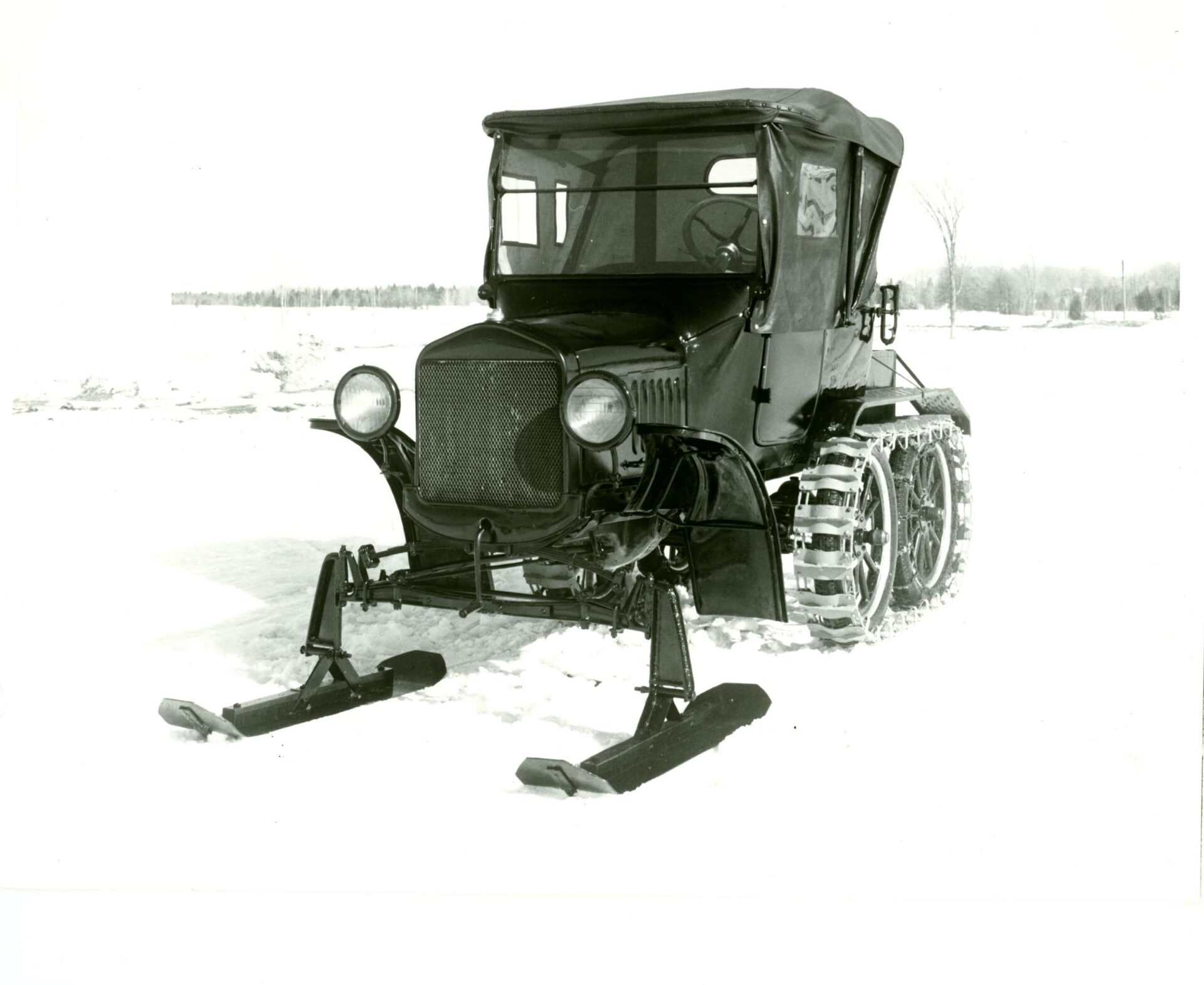
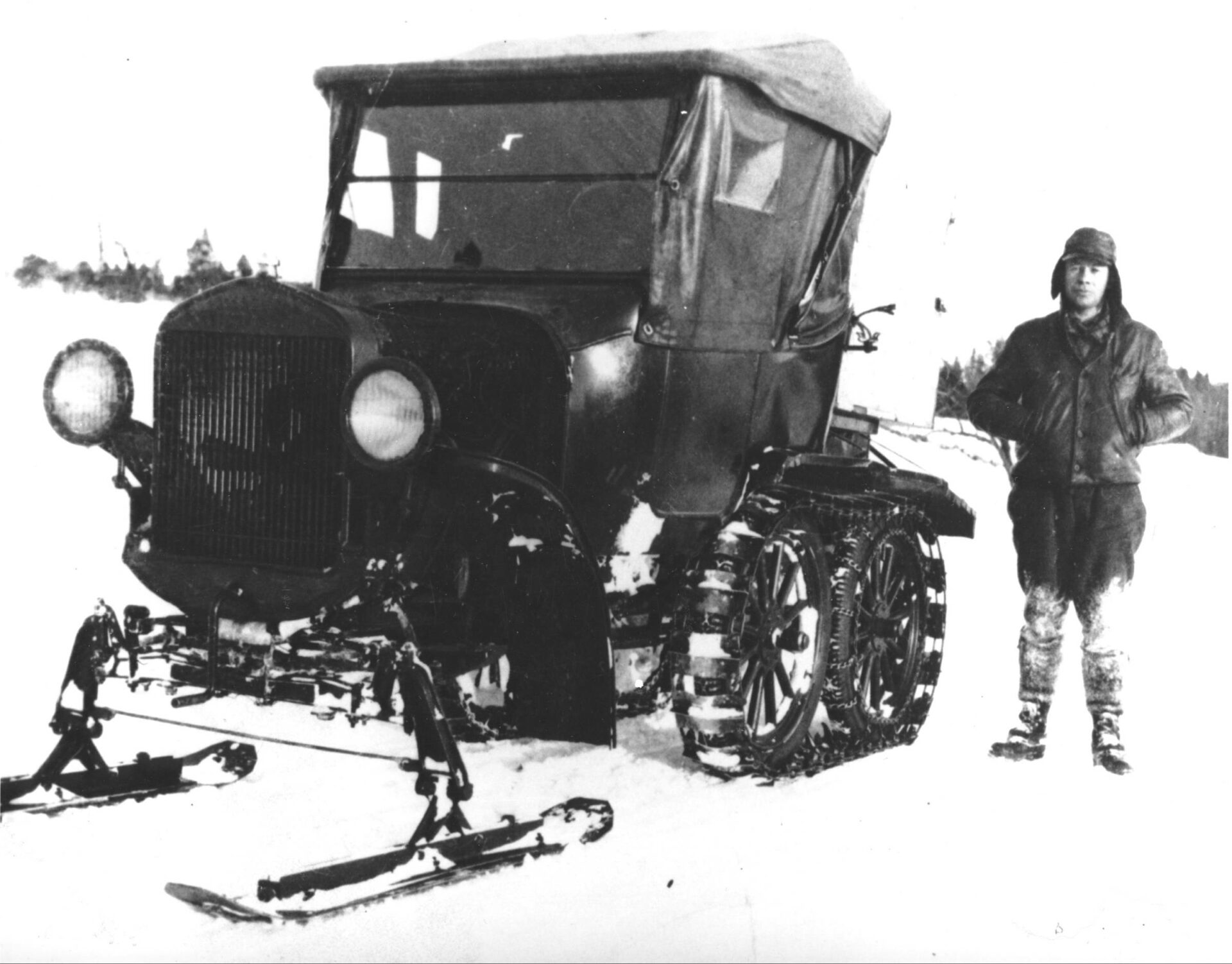
As early as 1927, Joseph-Armand Bombardiers was conducting a series of tests to develop a vehicle that could travel over snow. The inventor knew he would have to overcome three challenges: distributing the vehicle’s weight, designing a reliable traction system, and developing a good suspension system. Track systems used at that time for winter travel were generally designed by replacing the front wheels of existing vehicles with skis and adding wheels at the rear to accommodate a rigid track. Drawing inspiration from these systems, he developed in 1929 a metal track system for a Ford Model T automobile. Joseph-Armand Bombardier developed a metal track system consisting of steel plates connected by chain links. He added a second set of wheels at the rear of this car to install his track system. He replaced the front wheels with skis.
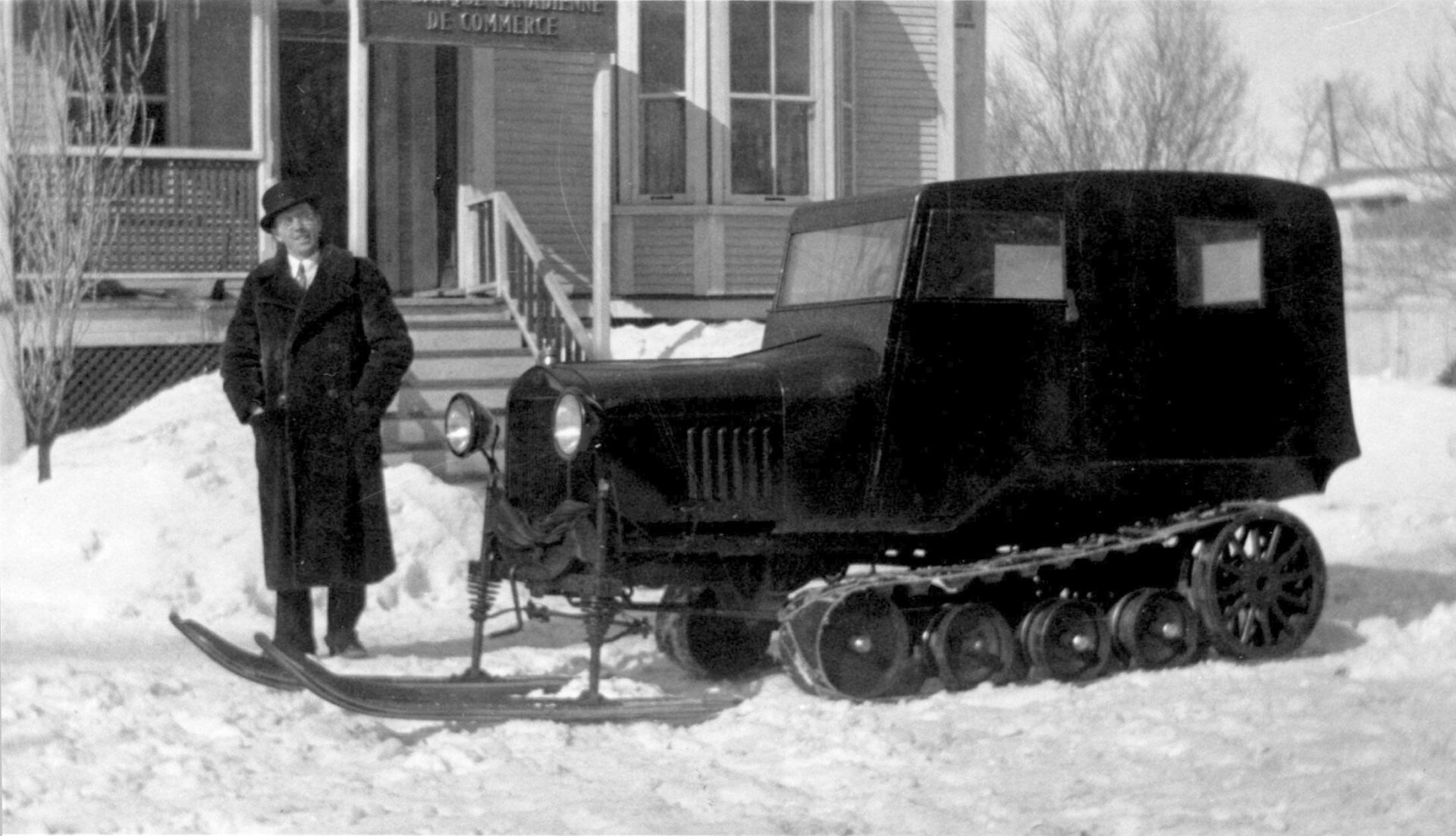
In 1931, Joseph-Armand Bombardier used a longer, flexible track made from a conveyor belt and driven by a drive wheel, which he also installed on a Model T. This vehicle offered better traction and greater floatability on the ground, and was therefore more reliable. At the rear, he installed double drive wheels connected by metal tubes, between which he inserted wooden blocks to drive the track, ensuring better movement. Smaller wheels were fitted on either side, enhancing the suspension’s flexibility. They were made from brake drums. He replaced part of the steel bodywork with plywood, making the vehicle lighter. Here, we can see notary Antonio Grandpré standing alongside the 1931 prototype.
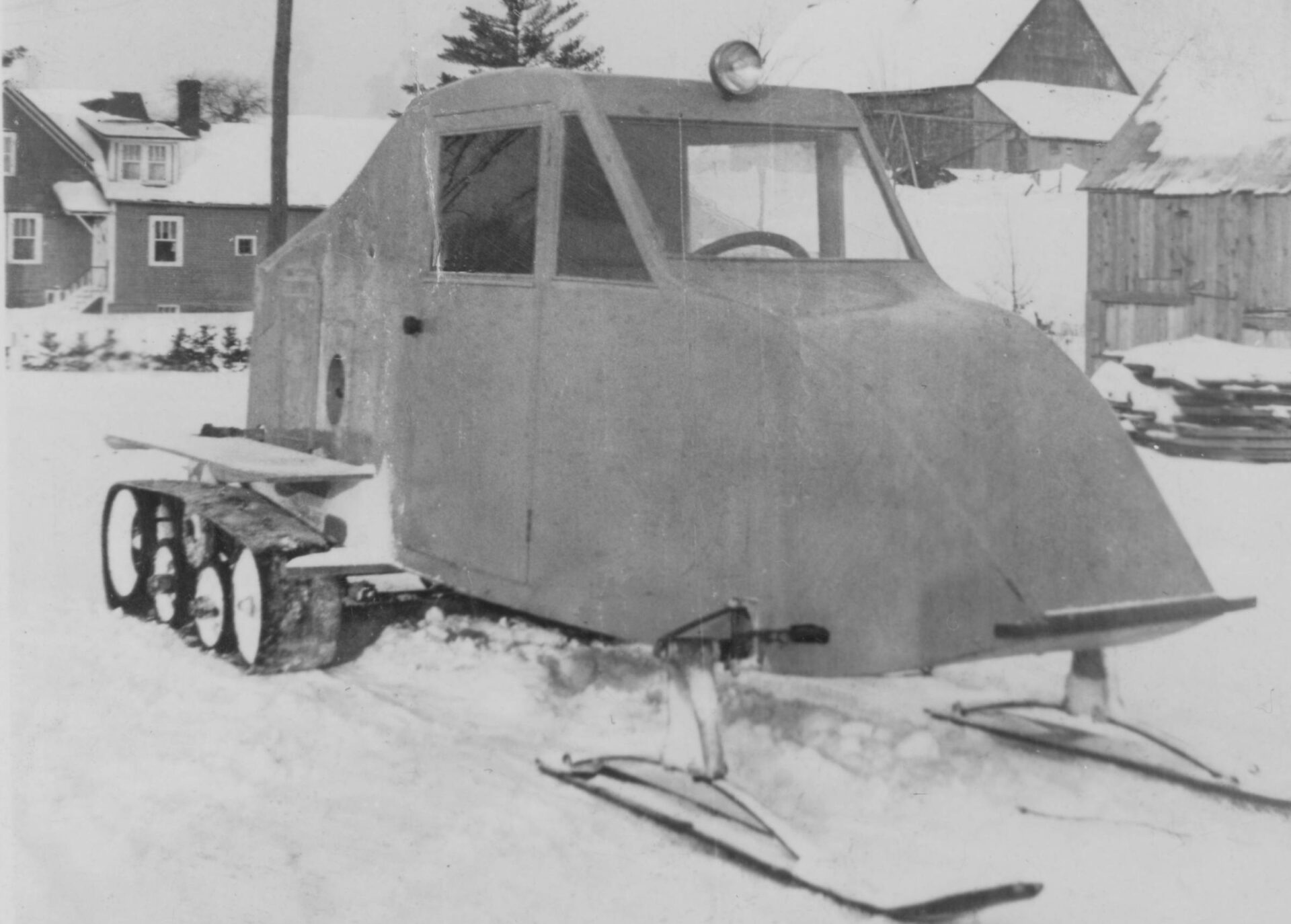
In 1934, Joseph-Armand Bombardier developed a single-seater to test the weight distribution and traction ratio. Aerodynamically shaped, with a lighter body, the prototype was powered by a four-cylinder motorcycle engine. Placing this engine at the rear of the vehicle transferred the weight to the tracks, improving floatability and traction. The drive wheels, located at the rear, provide an internal drive. However, snow continued to build up inside the traction system, hindering efficiency.
Joseph-Armand Bombardier stopped modifying automobiles, and decided to create a vehicle using a small engine placed at the rear, above the tracks, which are driven by a chain on a toothed gear. He installed the engine at the rear of the vehicle to shift the weight to the tracks, providing greater floatability and improved traction. He used a track system similar to that of the 1931 vehicle. In order to lighten the vehicle, he built a chassis basically made of wood.
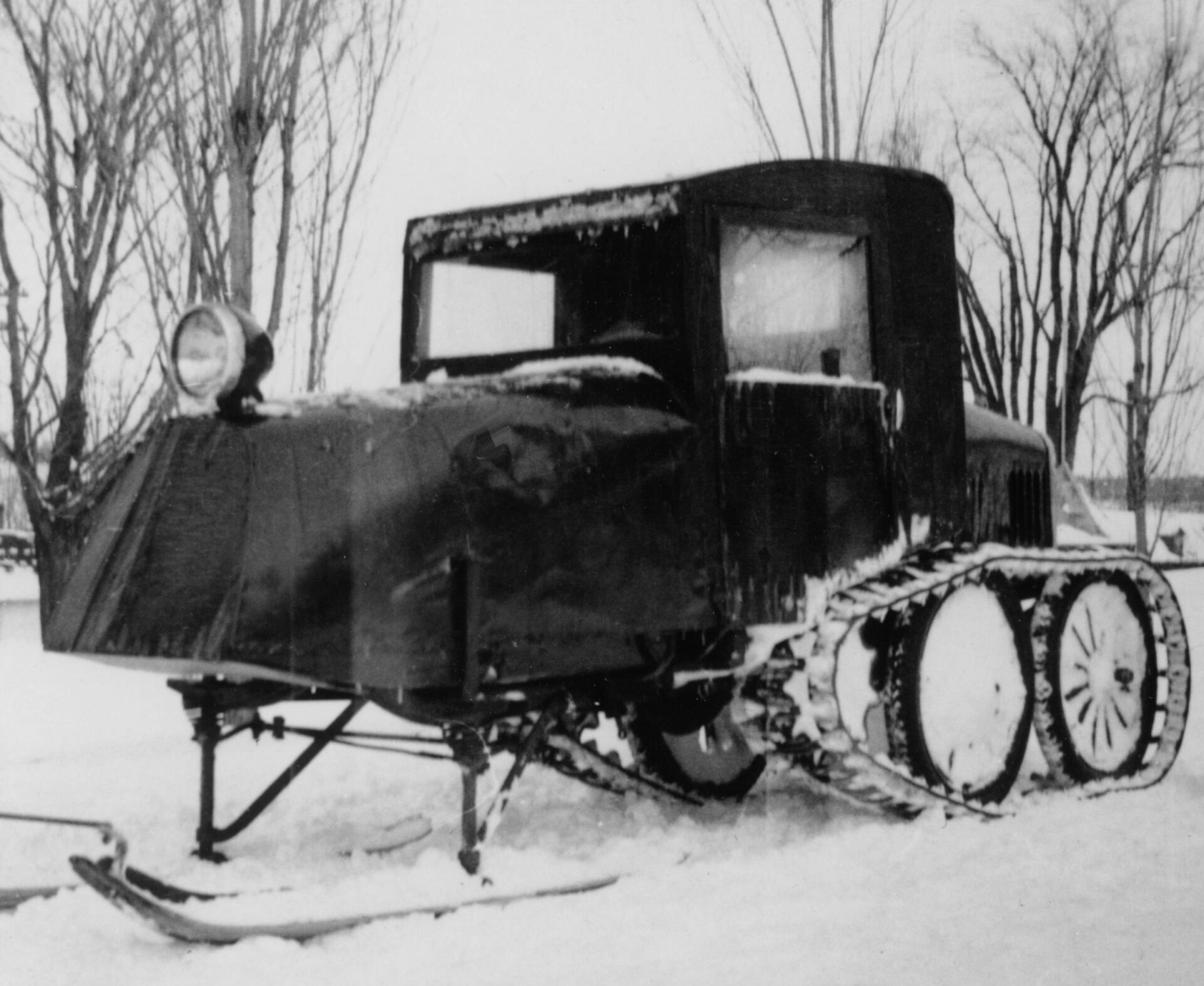
In 1935, the inventor pursued his research work on existing vehicles offering greater capacity. As in 1934, he placed the engine at the rear of the vehicle and lightened the body. Furthermore, he invented a new revolutionary traction system: the sprocket wheel/track system. A toothed gearwheel, made of wood and covered in rubber, drove the flexible track, made up of two rubber strips connected by steel cross-links. The openings between the steel plates and the rubber strips allowed snow to evacuate more easily. The use of rubber reduced component wear significantly. This first patented invention would influence the inventor’s career. The 1935 vehicle finally met Joseph-Armand Bombardier’s expectations.
Installing the engine at the rear of the vehicle ensured optimum distribution of the vehicle’s weight on the tracks, thus improving traction and glide on skis.
The sprocket transmitted the motive power to the tracks very efficiently. The openings between the steel cross-links and the rubber strips in the new system allowed snow to evacuate more easily. The use of rubber reduced component wear significantly. He manufactured a lighter body made of plywood, wood, and canvas. He installed two large tandem wheels for the suspension.
“I felt confident with this device and believed it had real potential for anyone wishing to address winter transportation issues.”
J. Armand Bombardier
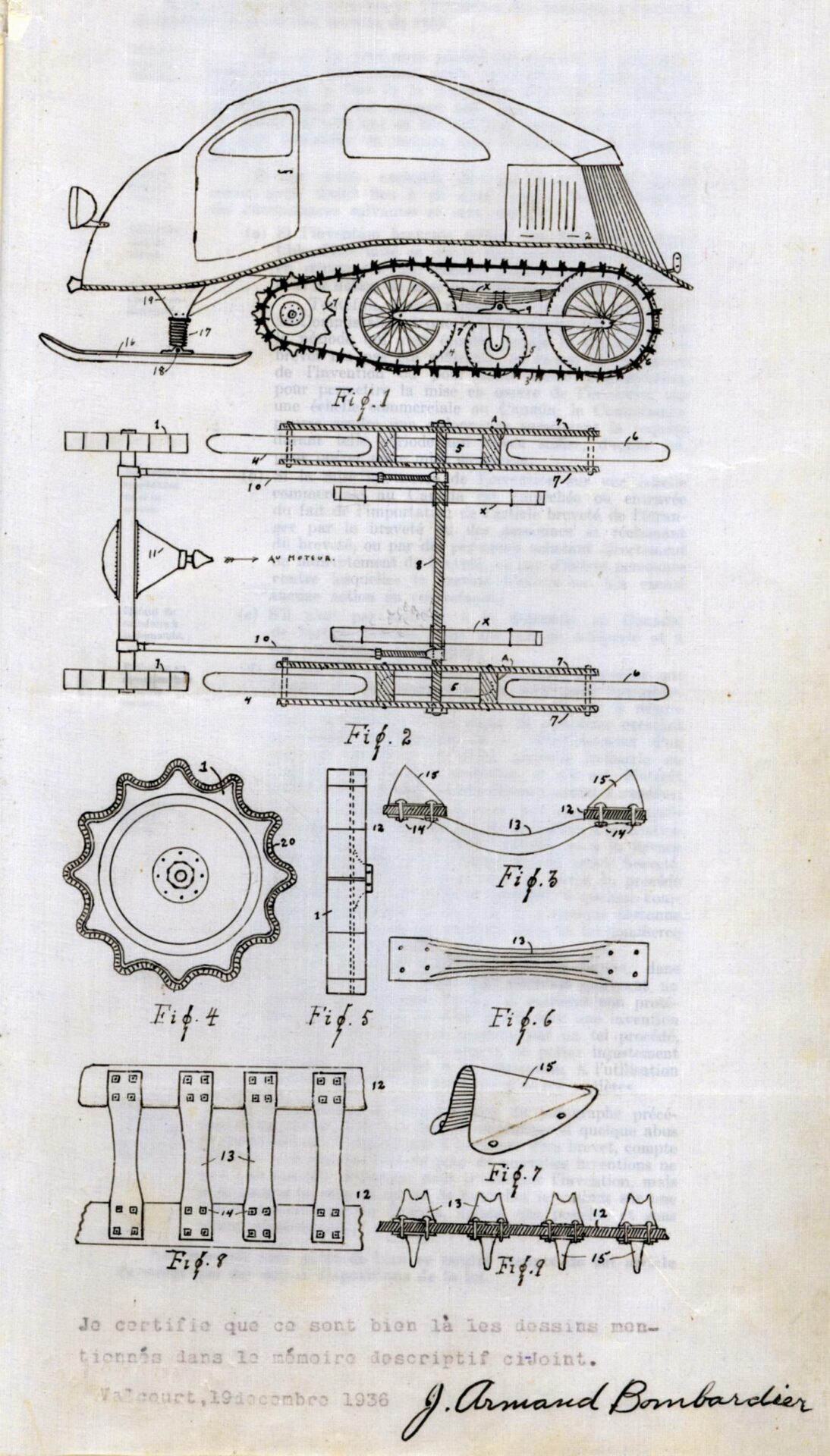
Technical drawing of Joseph-Armand Bombardier’s first patent no. 367104,
“Auto-chenilles pour la neige” (tracked snow vehicles), June 29, 1937.
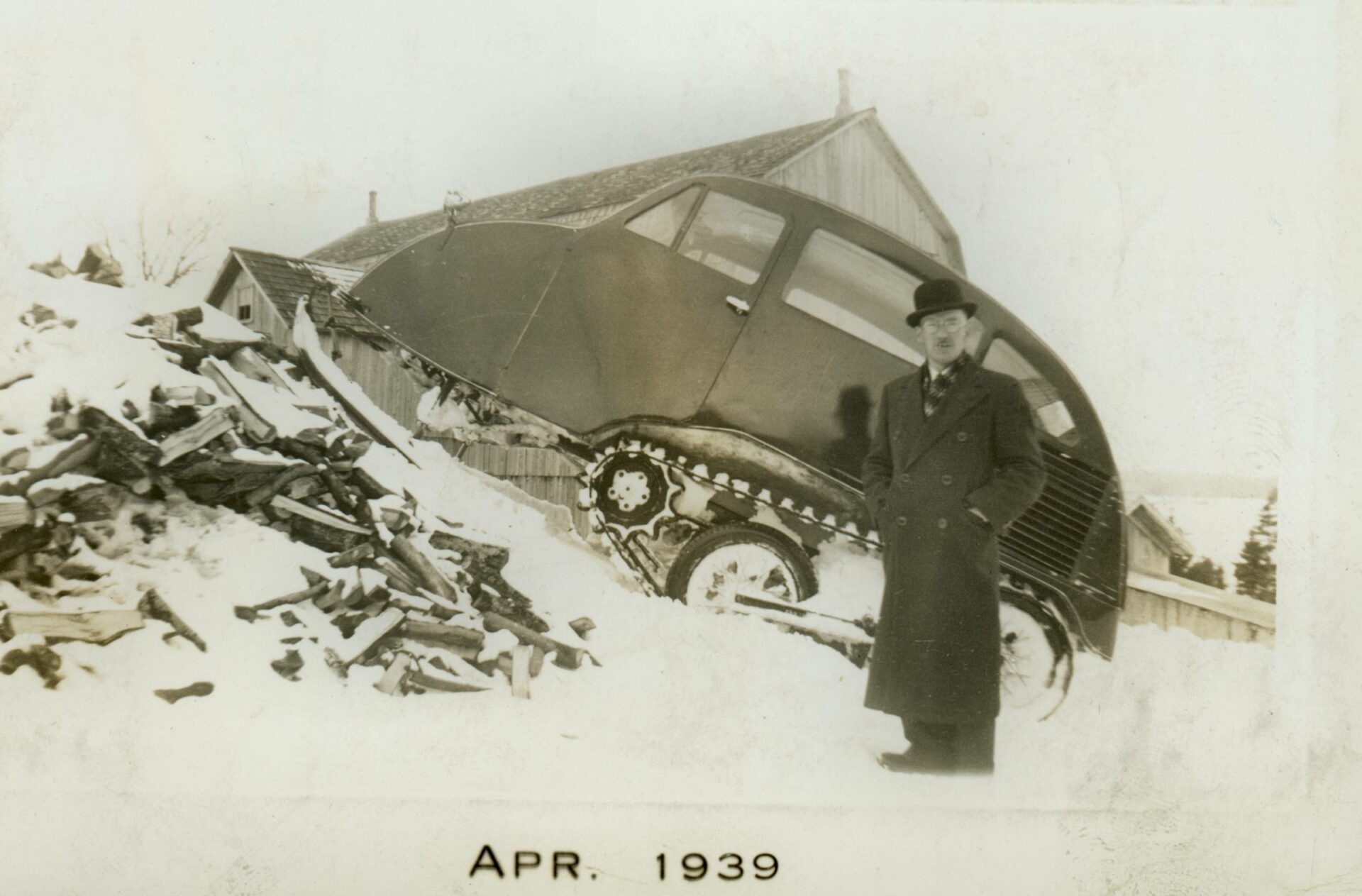
The first seven production snowmobiles were released in the winter of 1936–1937. They were designated B7, B for Bombardier and 7 for the number of passengers they could accommodate. These vehicles were a great success. The inventor was always looking for ways to improve his products.
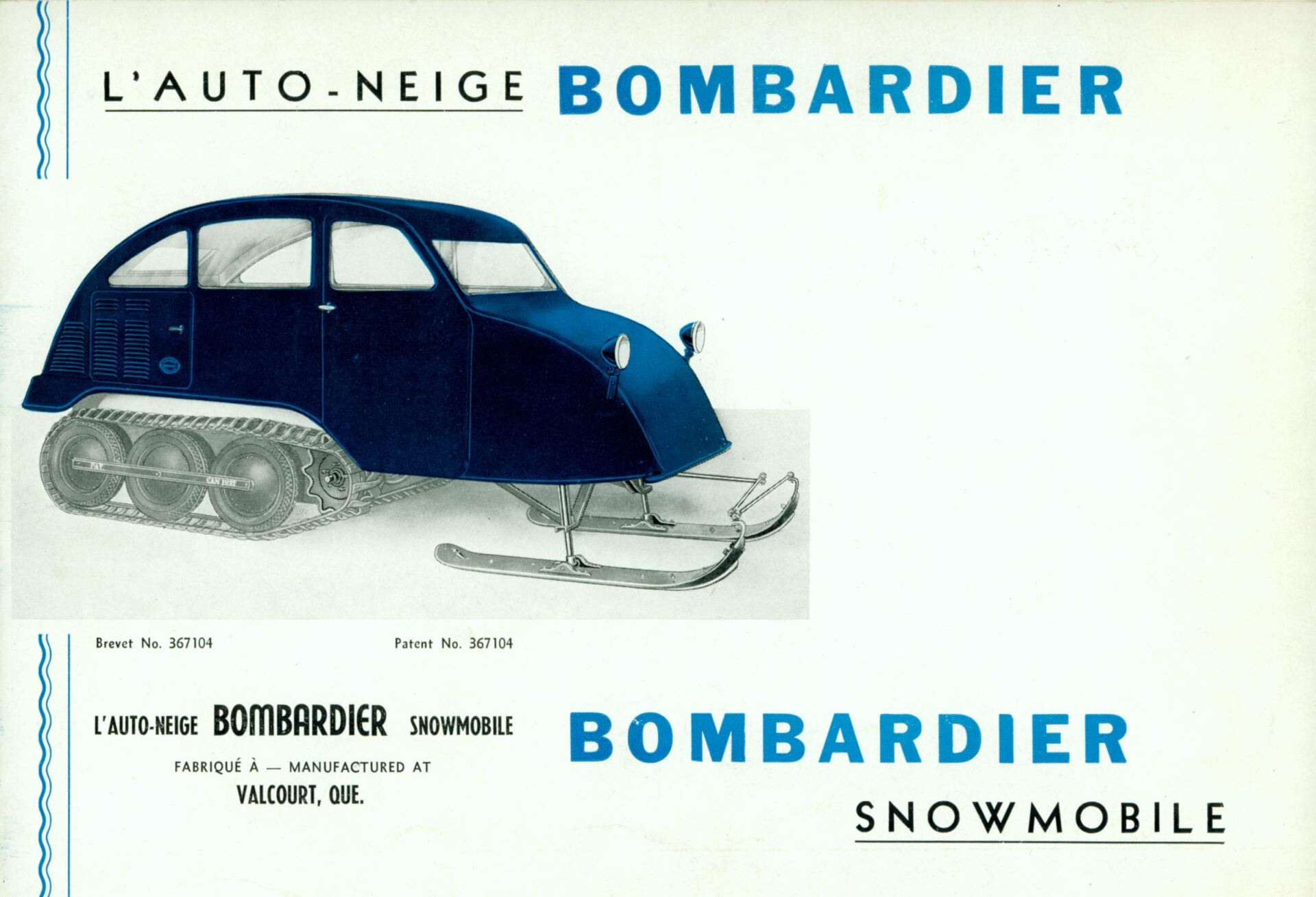
Joseph-Armand Bombardier began mass production in 1937. After improving the 1935 prototype, the inventor-turned-entrepreneur developed a vehicle that could carry seven passengers, the B7, the first commercialized vehicle designed specifically for travelling over snow. The B7 model was very popular with professionals at the time, and soon became accessible to the general public. To increase the efficiency of the sprocket wheel/track system, small wheels are added to improve the rear suspension.
From 1940 onwards, the B7 model was equipped with a revised suspension system for improved traction; solid steel wheels replaced the spoked wheels, eliminating the risk of snow accumulating in the system. A front heater, a defroster with driver’s control, a six-volt electrical system, and a vacuum-operated windshield wiper were all standard features on the B7 snowmobile produced until 1944.
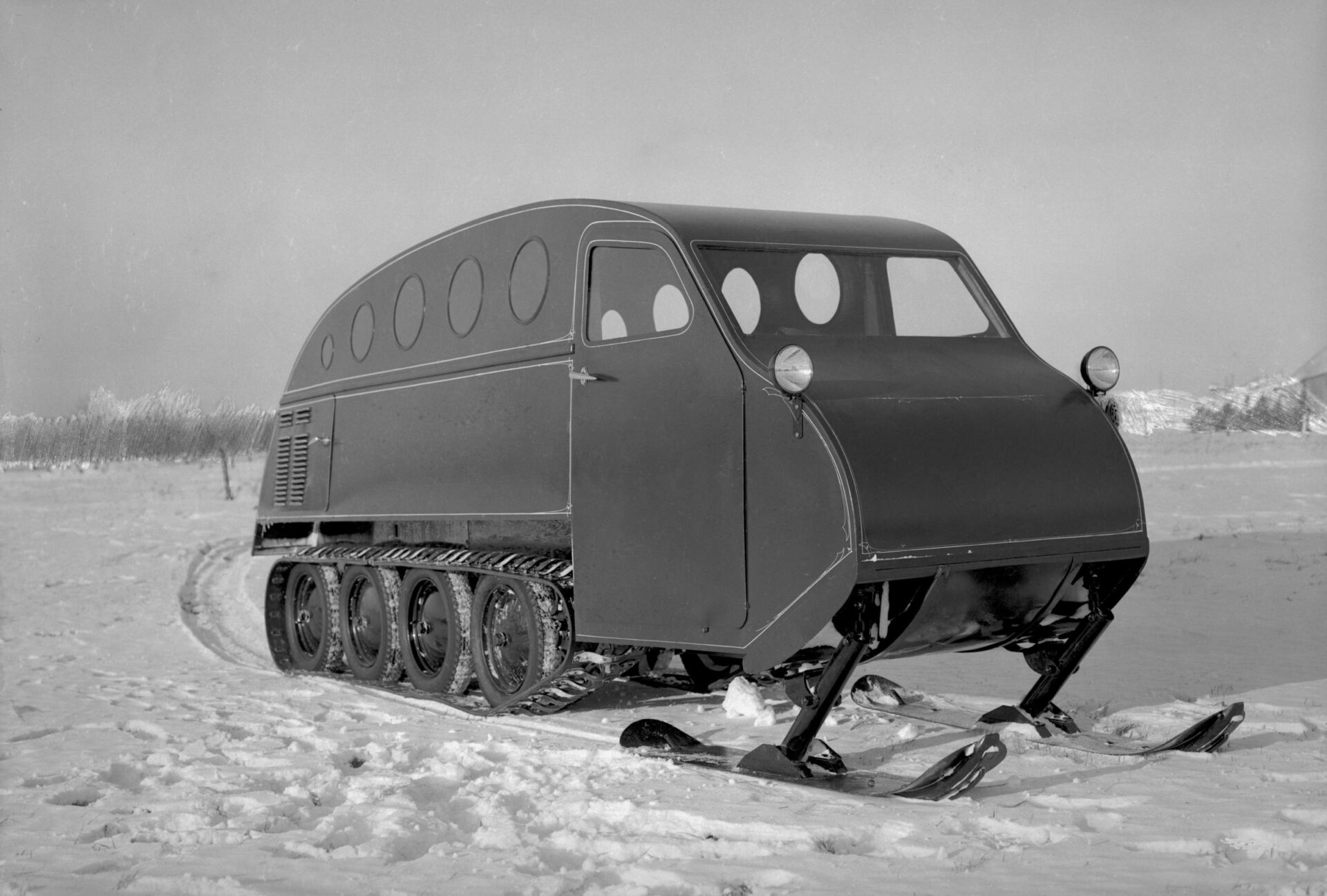
In 1941, Joseph-Armand developed a new snowmobile, designated B12, which was patented on June 23, 1942. With a 12-passenger capacity, this snowmobile had an elongated profile, giving it a more aerodynamic look than the B7 snowmobile.
Right from the start, the B12 snowmobile was a great success, with orders pouring in. A total of 2,817 vehicles were produced between 1941 and 1951 by the company in Valcourt.
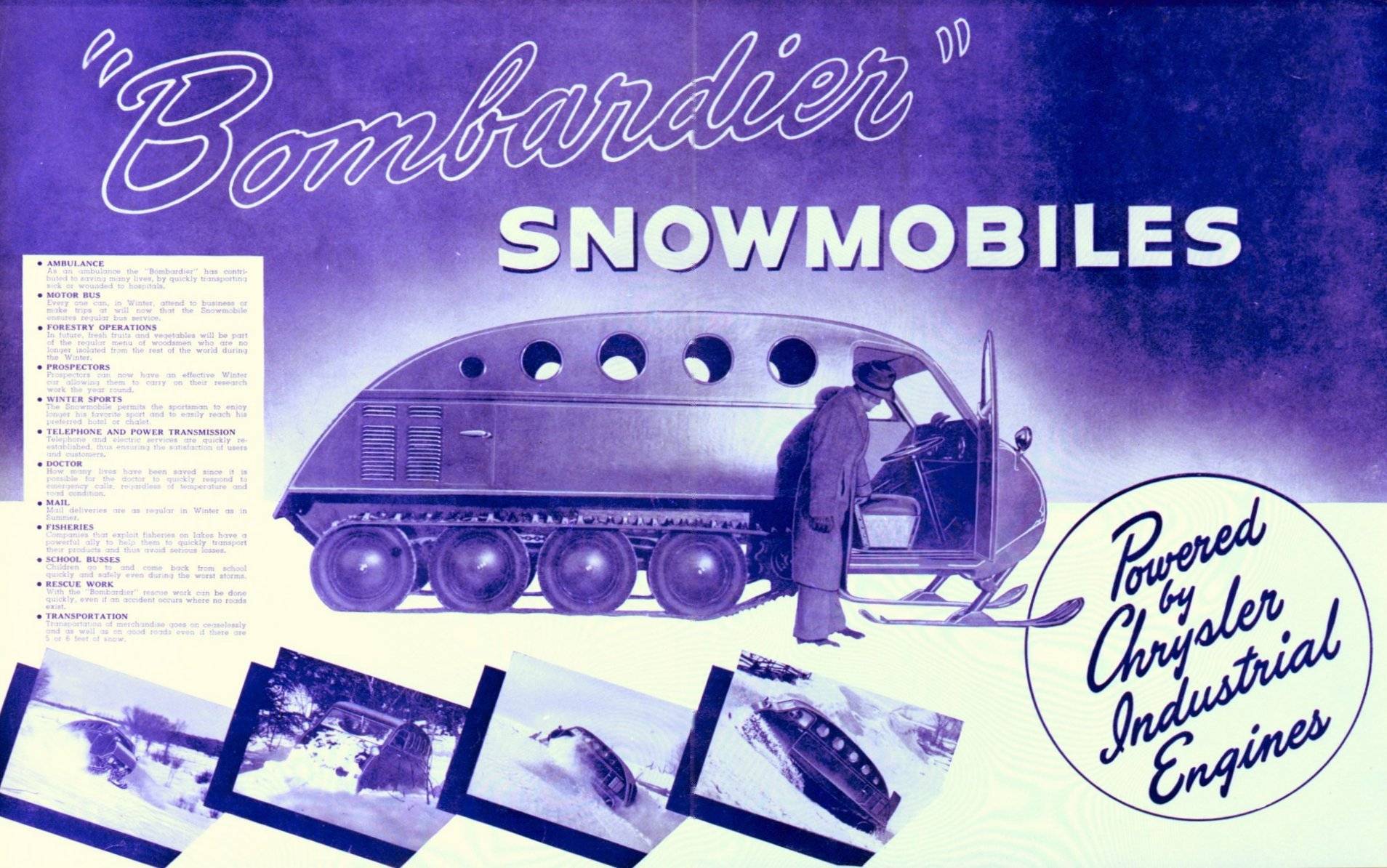
The B12 snowmobile, a resounding commercial success, was produced from 1941 to 1951. This iconic vehicle was then used as a bus and ambulance, as well as for transporting passengers in general, mail, food, and goods. Its toboggan-type frame ensured great floatability. In addition, the sprocket wheel/track system was further refined with this snowmobile: a rear suspension system with independent wheels was designed, giving the track better contact with the ground.
The B12 CS snowmobile, produced between 1944 and 1951, was equipped with a new, more powerful Chrysler engine. A remarkably capable vehicle, equipped with a six-volt electrical system and forced-air heating system, the B12 was a great success. Its versatility meant it could be used in different ways. Many will agree that this vehicle represents the golden age of Bombardier snowmobiles.